For some children, signing up for Saturday morning sport, wearing the team colours and taking home the player of the day award is not always possible.
For numerous reasons – autism, being on the spectrum, sight impairment, physical differences – these kids may find they are on the outer.
When St Columba’s Catholic School principal, Gareth Duncan, saw HUNGERBALL at a teacher-only day, he immediately saw the possibilities to create a club for his students with different abilities.
“Sarah Ryan from Sport Waikato mentioned that HUNGERBALL was available in the area and any schools could have a trial,” says Gareth.
“At the time, I was the Kāhui Ako lead, and we asked Andu to bring HUNGERBALL to our teacher-only day.”
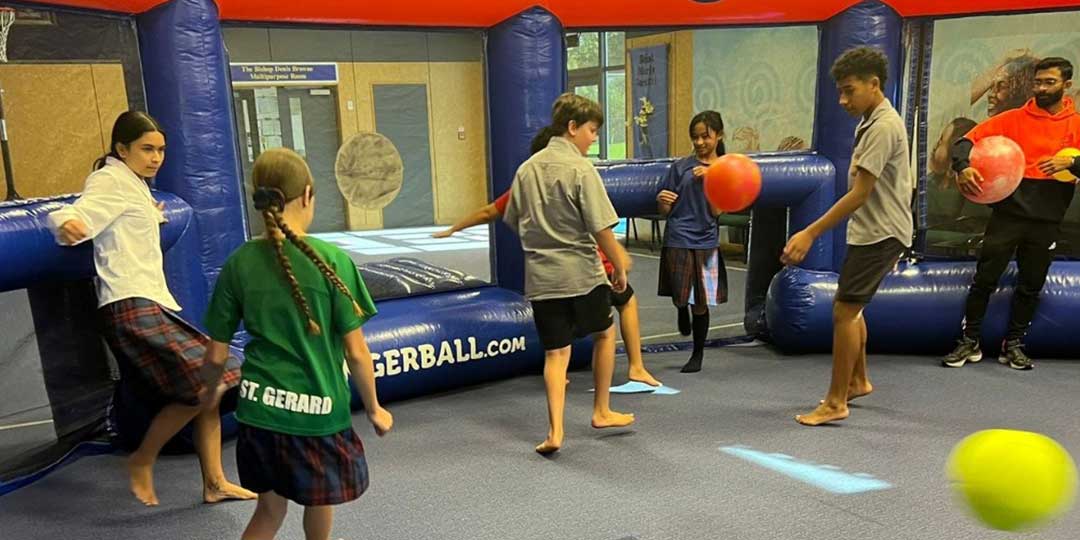
Students from a local high school played in the arena, modelling how the games could be played, and teachers quickly joined in.
“My first impression was – this is a grouse little unit. The level of fun was right up there for teachers and the high school kids.”
In 2024, a strategic goal for St Columba’s was for every child to participate in one sport and join a club, and this goal has continued into 2025. HUNGERBALL enabled the differently abled children to achieve this goal.
Gareth recognised that HUNGERBALL games levelled out the playing field between different ages and abilities, and he applied for Tū Manawa funding for St Columba’s. As the Kāhui Ako lead it enabled schools within the group to have access to the arena.
“The purpose was to include students who couldn’t successfully access sports or clubs. Where there was a lack of access for our autistic children, our spectrum-based children, for those who had physical disabilities and for those with vision disabilities at our school.”
The funding application focused on providing these children with an experience, and he called it the HUNGERBALL Club, for children who may be excluded from sports clubs they wanted to join outside of school.
St Columba’s application was successful, and they secured the use of a HUNGERBALL arena for a year.
Once a week, HUNGERBALL Club ran for 20 minutes after school, and there were variations of games coordinated by St Columba’s sports coordinator and learning assistant, Abby.
Afterwards, there were certificates, Player of the Day presentations, and a brief post-match afternoon tea.
One boy always knew when the HUNGERBALL Club was happening, and he often asked, “Mr Duncan, do I get my certificate today?”
“HUNGERBALL has provided a lovely, inclusive and delightful feel for those children who sit on the fringes of education and their relationships with other children at this tender age of finding a pathway with their peers. They just want to be treated as normal. To turn up for Saturday morning sport would be lovely, but often they can’t.”
Everyone went home happy, and the parents could build a narrative about playing HUNGERBALL and talk with their children about belonging to the club.
Gareth and Abby found that HUNGERBALL was easily used by teachers who were adaptive in creating different learning opportunities and expanding the skills of children.
Beyond the afterschool HUNGERBALL Club, every class in the school has access to the arena throughout the week. House leaders ran the HUNGERBALL Club during the lunch hour for different year groups.
“Watching children higher up in the school teach and coach little kids with disabilities has been beautiful.”
HUNGERBALL coaches taught the staff and students the different games, as well as how to set up the arena. They also accessed the series of videos HUNGERBALL developed to help users learn the ins and outs of running a session.
Gareth explained that HUNGERBALL levels the playing field by differentiating the tool and its use, for example, you might blindfold a skilled player or require them to touch the ball three times before they can score.
“You increase a skilled person’s barriers and decrease barriers for others. HUNGERBALL was useful for that. Essentially, everyone could score a goal. It was something that had an entry point for all levels.”
Often, it was used as a warmup for staff meetings, using pool noodles, and everyone was in boots and all. Staff who were more competent or competitive were slightly disadvantaged by having to play without a noodle or were only allowed to use their hands.
The MoveWell resource uses a fun, games-centred approach to develop children’s knowledge, attitudes and movement skills. The senior school utilised MoveWell to engage students through games, play, and skill-based practice. HUNGERBALL could be included as a station within a circuit, and kaiko could be creative with ball skills activities before children enter the arena.
Gareth has run HUNGERBALL events for external groups, including two other Kāhui Ako and a session for Sport Waikato about variations to St Columba’s sports programmes and strategy.
“I spoke about using HUNGERBALL in the strategy and then threw them all in the arena and showed them that this is what we are doing to find inclusion.”
They have hosted a Halberg Trust event for students with disabilities and lent it to schools within the Catholic Kāhui Ako.
“I put HUNGERBALL up every time we have a visiting school or function where it adds another attraction to show what education might be in this contemporary space around inclusion.”
People within the school community who hire the hall have used HUNGERBALL, and the after-school care programme often uses the arena.
It had so much mileage that in 2025, St Columba’s bought its own arena, and Gareth is working on getting a team uniform for the after-school HUNGERBALL Club.
“All teams wear a uniform, and this year is about putting the players in uniforms to make them feel very special, maybe with names and numbers on the shirts.”