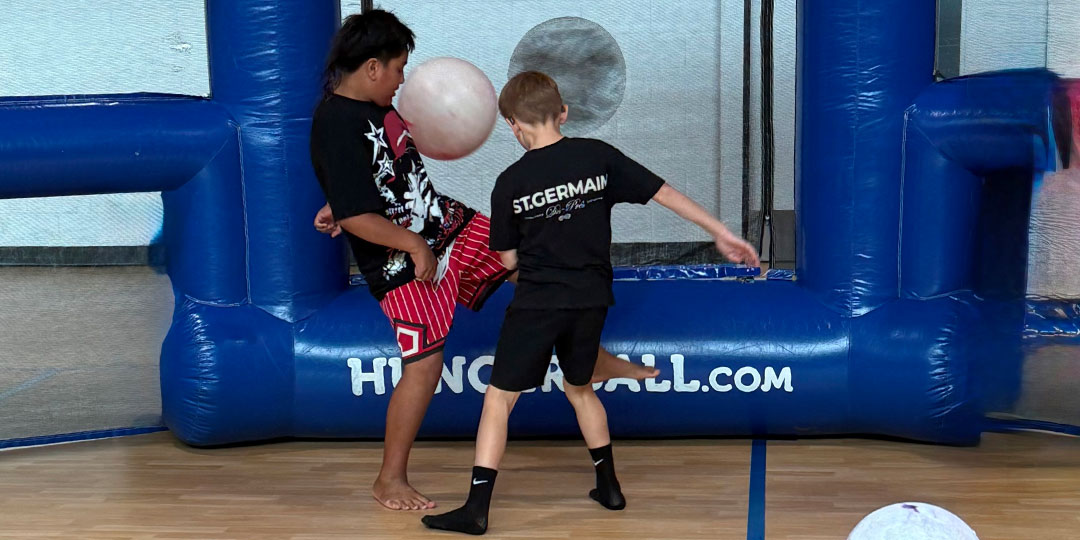
The beauty of HUNGERBALL lies in its inclusivity – empowering tamariki with low or no vision to have a blast in the safety of the inflatable arena.
Cathy West, immersion facilitator at BLENNZ, says HUNGERBALL is a safe environment for visually impaired students from all over the motu who come together for targeted learning and fun during their immersion courses at the BLENNZ Homai Campus School in Manurewa, Auckland.
“After discussion with the facilitator and their Resource Teachers: Vision (RTVs), tamariki understand they are in a safe environment within the HUNGERBALL arena and the balls will return. Having coaches and teachers in the arena is helpful, with all ākonga having an RTV beside them until they learn the rules and parameters of the game and are comfortable to take part,” says Cathy.
In 2024, BLENNZ had its first experiences with HUNGERBALL. Senior students who are blind took on a leadership role in coordinating a sports day, which included coaching and practising the game before arranging and organising an accessible sports day for the whole school.
“It was so successful, and the learners had so much fun. We had tamariki playing in wheelchairs, with their accessibility needs met so they could enjoy and get the most out of the game.”
“It’s attractive, providing for the sensory needs of visual, auditory and tactile learners, maybe looking like a bouncy castle, and the children enjoy the novelty of the arena. Plus, we can have it indoors or out depending on the weather,” says Cathy.
HUNGERBALL returned in May 2025, and plans are in place for the game to return for a further adaptive sports course later in the year.
Throughout the course, coaches focused on ball skills – one of the challenges youngsters with impaired vision experience in regular PE programmes. There were teaching sessions on catching and throwing, strategies around skills required and strategies to locate where other learners are. The arena worked well because it is completely enclosed: tamariki can call to each other to work out where their classmates are located before throwing the ball.
“Two HUNGERBALL coaches were in the arena; they were absolutely brilliant, helping the children to understand the layout of the arena and taking them around to identify where all the goals were and then introducing them to the range of balls they use.”
BLENNZ staff gave HUNGERBALL coaches advice on the children’s physical and visual needs, but Cathy says they are “on to it anyway” – understanding how to include tamariki with vision impairments. Strategies were developed to manage very sporty children, ensuring that less confident players had equal opportunities to play.
Many youngsters with vision problems struggle with PE at mainstream schools and are unable to get full benefit of heart-pumping activities. One of the tasks for BLENNZ RTVs throughout the country is to ensure that children have access to the entire curriculum and to adapt the programme for them. HUNGERBALL is a good fit with this objective.
“It helps the children with confidence, independence and risk-taking,” says Cathy. “In the last course, one young person, who doesn’t take part in much sport, absolutely loved it. I was amazed that he was right in the middle of it.”
What the Tamariki had to say about HUNGERBALL
“HUNGERBALL – it is a really cool game because it is fast-paced, it would be really fun to play with your close friends.”
“HUNGERBALL was the best. I learnt how to play it. When I kicked the ball, it was bouncy and fun to play with. It is a fast-paced game that makes you think on your feet.”
“It was helpful having a referee in the pit to help and run the game.”
“HUNGERBALL was really fun – I really loved it. Thank you for playing HUNGERBALL with us.”